 Cal
Cal
We hope you love the products we recommend and just so you know that as an Amazon Associate EngineHoist.net may earn from qualifying purchases.
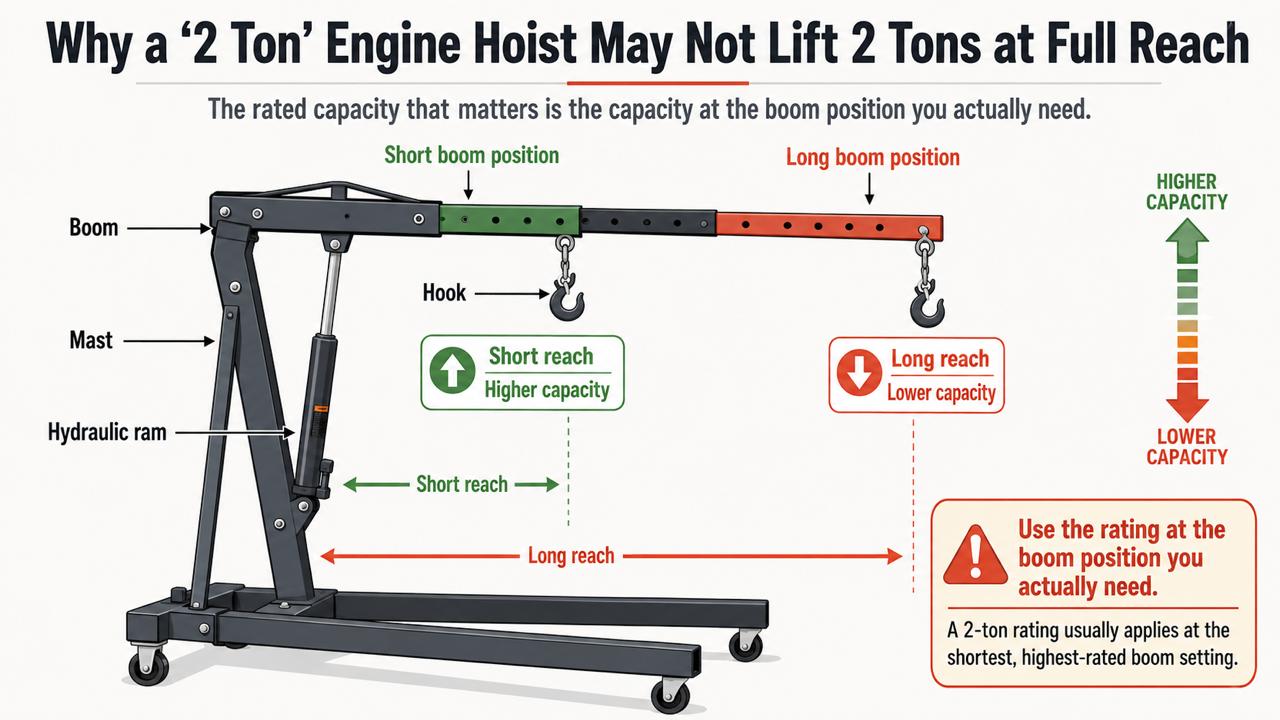
Fast answer: a shop crane’s headline 2-ton rating usually applies at its shortest, highest-rated boom setting, not at every boom position. As the boom extends for more reach, the rated capacity usually drops. The number that matters is the capacity at the boom position you actually need.
If you only remember one thing: use the rating printed on the boom decal or in the manual for the exact boom position that reaches the load.
- If the long-reach position is not rated high enough, the answer is not to “try it anyway.”
- The answer is to change the lift plan, use a different crane, rent a heavier unit, or stop until you can verify the setup.
Compare current options: 2 ton engine hoist buyer guide
What boom positions are
Most engine hoists use a telescoping boom. The outer section slides in and out, then locks into place with a pin through one of several holes. Each hole gives you a different combination of reach and rated capacity.
- Shorter boom position: less reach, usually higher capacity.
- Longer boom position: more reach, usually lower capacity.
This is why a crane sold as “2 ton” may only be rated for 1 ton, or even 1/2 ton, at the position you need for a deep engine bay.
Why capacity drops as the boom extends
The boom acts like a lever. The farther the hook sits from the mast and hydraulic ram, the more leverage the load creates against the crane.
A simple way to picture it: holding a dumbbell close to your chest feels easier than holding the same dumbbell straight out in front of you. The weight did not change, but the leverage did. A shop crane works the same way.
That is why longer reach usually means lower rated capacity.
What “2 ton” really means, and what it does not mean
For most folding shop cranes, the 2-ton label is the maximum rating at the shortest boom setting. It does not mean the crane can lift 4,000 pounds at every hole in the boom.
That is the mistake that causes bad purchases. Buyers shop the product title, then discover later that the longer boom setting they actually need is rated much lower.
If you are comparing cranes, ignore the headline first and look for:
- capacity at each boom position
- boom length or reach wording
- hook height if it is clearly defined
- surface and movement warnings in the manual
Position numbers are not universal across brands
This part matters more than most buyers realize: Position 1 does not mean the same thing on every crane.
- Harbor Freight 58755 and Sunex 5222 use Position 1 as the longer-reach, lower-capacity setting and Position 4 as the shorter-reach, higher-capacity setting.
- ATD-10141B does the opposite. Position 1 is the short, high-capacity setting and Position 4 is the long, low-capacity setting.
So never assume Position 1 is “best” or “safest.” Check the actual manual or boom decal for that model.
Representative examples from current cranes
These examples show the pattern clearly, but they are still model-specific. Do not use one crane’s numbers as a shortcut for another.
Harbor Freight Pittsburgh 58755
- Official page: Harbor Freight 58755
- Manual: Harbor Freight 58755 manual
- Published boom-position capacities: 1/2 ton, 1 ton, 1-1/2 ton, 2 ton
- Manual warning: capacity decreases as boom lengthens
Harbor Freight is the cleanest mainstream example of the basic rule, even though its height wording is still not clean enough to treat as verified hook height.
Sunex 5222
- Official page: Sunex 5222
- Manual: Sunex 5222 manual
- Published boom-position capacities: 1/2 ton, 1 ton, 1-1/2 tons, 2 tons
- Published boom extension and max/min boom height by position
Sunex is useful because it gives more position-by-position dimensional detail than many retailer pages, but the manual still says boom height, not hook height.
ATD-10141B
- Official page: ATD-10141B
- Manual: ATD-10141B manual
- Published boom-position capacities: 2 ton, 1-1/2 ton, 1 ton, 1/2 ton
- Published min hook height and max hook height by position
ATD is the best example in this set for terminology clarity because the manual defines hook height as the measurement from the floor to the bottom of the hook.
Duralast 80900T
- Official page: Duralast 80900T
- Current validated manual: UNKNOWN
Duralast is a good real-world example of why caution matters. The AutoZone page confirms a 4-position telescoping boom and gives a capacity range, but exact boom-position capacities are still UNKNOWN until the current manual or boom decal is verified.
AFF 3584 as the step-up example
The AFF 3584 is not a direct peer to most folding 2-ton home-garage cranes. It belongs here as the “what if 2-ton is not enough?” example.
Why it matters: it shows how a heavier-duty crane can retain more useful capacity at longer positions than many 2-ton units.
If you want to compare live buying options while you read:
Check Sunex 5222 listings on Amazon
Check ATD-10141B listings on Amazon
Check current 2-ton hoist prices on Amazon
These Amazon links are best used as live listing checks, not as proof of exact spec details. Always confirm boom-position ratings and dimensions against the product page or manual.
How to choose the right boom position
- Identify the load. Engine only is different from engine plus transmission. If weight is unknown, stop pretending the setup is known.
- Include rigging. Chains, hooks, slings, shackles, lift plates, and load levelers all matter.
- Identify the reach you need. The shortest boom setting is only useful if it can actually center over the load.
- Identify required hook height. You need enough clearance to lift the engine clear with your actual rigging installed.
- Choose the shortest boom setting that still reaches. Shorter usually gives more capacity, but only if it physically works.
- Verify the rating at that exact position. Use the decal or manual for that model.
- Check the lowest-rated component in the system. The hoist is not the only part that can limit the lift.
Hook height vs boom height vs lift height
This is where a lot of shopping pages get messy.
- Hook height: the measurement buyers usually care about most, because that is where the load connects.
- Boom height: may describe the boom itself, not the bottom of the hook.
- Crane height: can mean the overall height of the crane or boom structure.
- Lift height or maximum height: often retailer shorthand unless the manual defines the measurement clearly.
ATD is the strongest example in this group because it explicitly labels hook height. For Harbor Freight, Sunex, and Duralast, some published height numbers remain UNKNOWN as hook height unless the source clearly says otherwise.
Related: How high can an engine hoist lift?
Reach matters just as much as capacity
A crane can be “strong enough” on paper and still be wrong for the job if it cannot reach into the engine bay properly. That is why buyers should not shop by tonnage alone.
Longer reach often forces you into a lower-rated boom position. If that lower-rated position is not enough for the load, you need a different crane or a different plan.
Related: How big of an engine hoist do I need?
Rigging can reduce usable clearance
Even when the crane has enough raw height, the actual lift can fail on clearance because the rigging eats vertical space.
- A load leveler helps control angle, but usually costs you height.
- Longer chains can make the engine hang lower.
- Lift plates, brackets, hooks, and slings can change how the load hangs and how much room you have left.
That is why the practical question is not just “How high does the crane lift?” It is “How high does the hook lift with my rigging installed?”
When the right answer is a different crane
Sometimes the correct answer is not a different boom hole. It is a different crane.
You should step up, rent, or stop if:
- the boom position that actually reaches is not rated high enough
- hook height is insufficient after rigging is installed
- the load weight is unknown
- the boom decal or manual is missing or unreadable
- the floor is not hard, level, and capable of supporting the lift
- the lift involves engine plus transmission and the geometry is uncertain
Related: Best 3-ton engine hoist and Where to rent an engine hoist
Used and rental checklist
If you are buying used or renting, ask the same question first: Where are the boom-position ratings?
- Do not rely on the product title alone.
- Do not accept missing or unreadable rating labels as “close enough.”
- Verify pins, clips, hook hardware, casters, and hydraulic condition before the lift.
Related: Where can I rent an engine hoist? and Engine hoist won’t lift
FAQ
Does a 2-ton engine hoist lift 2 tons at every boom position?
No. In most cases, the 2-ton rating is the maximum at the shortest, highest-rated boom setting. Longer boom settings usually carry lower ratings.
Why does capacity drop when the boom extends?
Because the hook sits farther from the mast and ram, which creates more leverage against the crane. More leverage usually means a lower rated capacity.
Is Position 1 always the strongest boom position?
No. Position numbering varies by brand. On some cranes Position 1 is the longest, lowest-rated setting. On others it is the shortest, highest-rated setting.
What is more useful, boom height or hook height?
Hook height is usually more useful because that is where the load actually hangs. But many product pages do not publish clearly defined hook height.
What if the manual does not show exact position ratings?
Treat the missing values as UNKNOWN until you can verify the current boom decal or current manual for that exact model.
Related guides:
Disclosure: EngineHoist.net may earn from qualifying purchases. See affiliate disclosure.

